The 2013 Australian Film: Face to Face
This was the official website of the 2013 Australian Film: Face to Face. The content below is from the site's archived pages and Rotten Tomato reviews.
Rating:NR
Genre: Art House & International , Drama
Directed By: Michael Rymer
Written By:Michael Rymer , David Williamson
In Theaters:Jan 11, 2013
Limited On DVD:Mar 19, 2013

SYNOPSIS
From Australia’s most acclaimed playwright, David Williamson, a moving and powerful new film about lies, betrayal, sex and bullying in the workplace. A young construction worker rams into the back of his boss’s Jaguar in a fit of anger at being sacked. Rather than fronting court, he’s given the chance to explain his actions in a community conference. This face-to-face confrontation between the young man, his boss, his boss's wife, co-workers, best mate and mother lifts the lid not only on his dysfunctional life but on their workplace dirty laundry, turning all of their lives upside down. Face to Face stars a stellar ensemble cast led by Vince Colosimo, Sigrid Thornton and Luke Ford and is directed by Michael Rymer (Angel Baby).
+++
The reviews below certainly are accurate in their assessment of this Australian film. I saw it when it first came out. As a recovering victim of workplace abuse, "Face to Face" resonated deeply with me. The film's portrayal of lies, betrayal, and bullying in a toxic work environment was both powerful and cathartic. Like the young man in the movie, I too turned to unhealthy coping mechanisms, finding temporary solace in alcohol and drugs. However, my journey to recovery led me to a meaningful refuge in sports, particularly golf.
As a female golfer in a male-dominated sport, I found strength in asserting myself and discovering the therapeutic benefits of the outdoors. The challenge of being a lefty and finding the right equipment was a metaphor for the struggles I faced, yet overcoming these obstacles empowered me. This film helped me understand that I am not alone in confronting workplace abuse and offered insights into managing my life better. It beautifully captured the complexities of such experiences and the importance of finding a path to healing.
So I get Face To Face in a very personal way. My husband and I both found it riveting and encouraged friends to see it, if possible.
+++
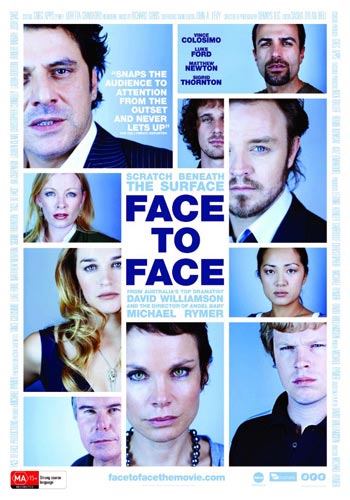
REVIEWS
“Face to Face is that rare film which grabs a hold of you at the beginning and doesn't let go till the end. It is an amazing piece of cinema – riveting, thought-provoking, transformative. Only once or twice a year do I see such a film – and this year that film is Face to Face.”
Michael Moore
* * *
“ 4 STARS, Terrific! a really riveting piece of drama and his cast triumph"
Margaret Pomeranz, At The Movies, ABC
* * *
“ 5 STARS, An Aussie film that easily slips into my Top Ten Australian Films of All Time. In face Face To Face is so good that if it were an American Film you can guarantee that people would be mentioning its name in the same sentence as the word Oscars”
Dave Griffiths, Buzz Magazine
* * *
“ 4 STARS, An engrossing tale. Vince Colosimo nails his part, Luke Ford - Excellent, Matthew Newton - Perfect. Its Fabulous!”
Richard Wilkins, The Today Show
* * *
“4.5 STARS - Floating between strong tensions and sharp humour, it's marvelous viewing that will please those who see Australia as a country making world-class films unblemished by the cliches of pop culture. It's packed with surprises. Every performance is right on the mark. And despite its serious core, it sends us out with warm fuzzies."
Dougal Macdonald, City News
* * *
“A powerful, engaging film that delivers insight and emotional punch…Astringent & Gripping, Face To Face is a triumph."
Andrew L. Urban, urbancinefile.com.au
* * *
“It is the perfect crucible, and of course, nothing is what it seems…Face to Face is an example of the quality that can be achieved when you start with a good script, and stay true…is sure to be one of the best Australian offerings of the year.
Rebecca Butterworth, Filmink MIFF Coverage
* * *
“The film is entirely believable. To such an extent that the momentum, the revelations, the emotions, the perspectives and the performances peel away the layers to find the core of the problems and leave you believing a fair resolution will be achieved.”
LYN MILLS, Canberra Times
* * *
"Rymer combines crisp, fluid camerawork with a flowing, penetrative script that he adapted from David Williamson's play. The result is a small-scale character-driven work that stands tall, gliding smoothly between introspective stillness and dramatic fireworks.
Simon Foster, SBS Film
* * *
"The film's crowning beauty is its fluidity. The conversations, loaded with humorous tilts, entwines back-stories, flashbacks and character motivations until the audience's initial moral judgements are almost completely upturned.
Luke Buckmaster, Cinetology
* * *
“Everyone's dirty laundry gets raised up the flagpole in Face to Face, a bristling little Australian indie that lands its many punches with pungent power. Within the format of a community conference – an Australian technique of airing differences with the hope that reconciliation can avoid official legal proceedings – what seems like a simple case of a wild youth's violence fans out to expose a far deeper and comprehensive set of ills. Winner of the Santa Barbara Film Festival's independent feature award, this smartly enacted issues drama snaps the audience to attention from the outset and never lets up…”
Todd McCarthy, Hollywood Reporter
* * *
"My problem with Face to Face is that, hard as I try, I can’t find any flaws. The film opens with a shock, a scene that looks like road rage, but isn’t. From then on, nothing is what it seems, as a cast of variegated characters decides the offender’s fate. I found myself stuck to my armchair waiting for the next Pirandello-like unravelling of character. Audience assumptions are built and peeled away, one surprise follows another to reveal identities and relationships. It isn’t easy to maintain pace when the focus is on a small set of men and women sitting in a single room, but Australian Director Michael Rymer has a deft hand. The casting is superb, the attention to detail stunning. Face to Face lived up to its promise - a film as powerful and riveting as 12 Angry Men. Can Rymer’s next effort maintain the momentum?"
Lois Bolton, Monaco Diary & BAM News, Monaco
* * *
"One of the most powerful movie of the 21st Century. Movie making at its best"
Georges Chamchoum, Artistic & Program Director Monaco Charity Film Festival
+++
TomatoMeter
Critics 91% | Audience 88%
CRITICS REVIEWS
Face to Face
September 8, 2011 By Glenn Dunks
Directed by Michael Rymer
Ten people sit inside a recreation hall fitted with only a collection of sturdy, if uncomfortable, chairs and a table with cups and a jug of water on it in front of an unmanned bar. This is the no frills setting of Face to Face, an unfussy adaptation of the David Williamson play of the same name. Written and directed on a tightly-reigned leash by Michael Rymer (Angel Baby), Face to Face will never be mistaken for the most exciting film of the year, but it’s a bold one nonetheless that rewards viewers with spiky wordplay and tart performances from a cast of big names and lesser knowns.

Assembling in this hall are the key individuals involved in a particularly nasty workplace dispute that ended violently when Wayne (Luke Ford, Animal Kingdom) rammed his reinforced ute into the back of Greg Baldoni’s (Vince Colosimo, The Wog Boy) sports car. This so-called “restorative justice session” aims to allow the parties to avoid the legal consequences of court and settle it “face to face”, but what the group’s leader – an authoritative Matthew Newton (Underbelly: A Tale of Two Cities) as Jack – can’t control are the threads of lies and deception that these people that begin to unravel parallel to the central issue at hand.
Wayne is a dim bulb, whose history of family abuse formed within him a short fuse that makes him ripe for workplace bullying. But when a particularly mean-spirited joke plays out involving himself, flirtatious company secretary Julie (Laura Gordon, Twentysomething) and meek accountant Therese (newcomer Ra Chapman), and enacted by ringleader Hakim (Robert Rabiah, Under the Radar), Wayne is fired and takes his frustration out on his boss in the driveway of his luxury mansion that doesn’t quite befit a man who pays his workers less than the average industry wage. Issues of race, class, greed and sexuality are weaved throughout Rymer’s screenplay as infidelities, betrayals and disgraces begin to tumble out of the guests mouths as if unfiltered between their brain and their speech.
If Face to Face is all a little too neat and tidy – you can all but see the ribbons and bows being tied on various plot strands as soon as they’re resolved throughout the brief 88 minute running time – then that’s certainly not the fault of the ensemble cast, who continue to give their characters new angles and shadows until the very end. The way Colosimo continuously adjusts his masculine stance in the room as he routinely touches and flares attention to his expensive designer suits that are in stark comparison to everyone else’s attire in the room is a particularly humourous touch. So too is the way Chapman’s shy Therese is routinely seen at the edge of the frame and in background shots not saying a word, representing the way she casually observes yet rarely partakes in her workplace’s office politics. When she emerges out of her shell, Chapman lets rip with a boiled over personality as if she’s never been given the opportunity before.
It’s up to two elder female cast members to hold the whole thing together though. As duelling mothers and wives, Lauren Clair (Matching Jack) and Sigrid Thornton (SeaChange) bring a dignified touch to the material that is otherwise missing amidst the rather working class cast of characters. Dennys Ilic does what he can with the straightforward cinematography, but the film’s unheralded team member will surely be editor Sasha Dylan Bell who creates swift and concise passages out of the lengthy text whilst elsewhere implementing a Rashômon effect for flashback sequences that show the dastardly deeds being discussed. It is a refreshing way of expanding the stage-bound material outside the four walls of its set without coming off as silly like many other films do.
Engaging, but rarely pompous, Michael Rymer’s Face to Face pokes at important issues and ones that are rarely explored in contemporary Australian cinema in such a forthright, verbose manner. There’s a delicious camaraderie between the cast that sparks on screen whilst Rymer and his crew have somehow found a way to make the film’s stage origins less irritating and, instead, work for the material. It’s less about achieving some sort of grand cinematic revelation than it is watching talented actors muse of prickly issues and provoking audiences to do the same. I guess you could say it’s like a play, but cheaper.
+++
Film review: Face to Face
LEIGH PAATSCH NATIONAL FEATURES

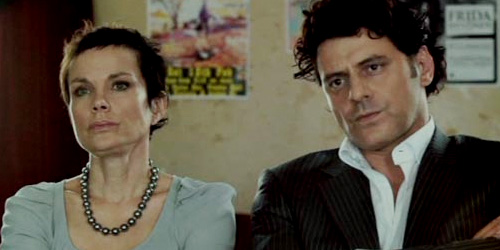
Face to Face (M) Director: Michael Rymer (Angel Baby) Starring: Vince Colosimo and Laura Gordon (above), Sigrid Thornton, Luke Ford, Matthew Newton. Verdict: Look. Listen. Learn. Stars: * * *
THIS here's what they call "a tough sell": an Australian movie where people sit around in a community hall and talk about their problems for 90 minutes.
This here's also what they call in the real world "a recipe for disaster". And yet, Face to Face keeps finding a way to rise above most viewers' worst expectations. To be fair, few will be going out of their way to see this punchy, low-budget, high-intensity drama.
Nevertheless, none of the intrepid, curious or just plain patriotic movie-goers who happen along the film will regret it. Adapted from a work by veteran Australian playwright David Williamson (Don's Party), the film verbally rakes over the coals of a fiery workplace dispute.
At the invitation of an independent mediator (Matthew Newton), all interested parties have pulled up a chair to present their perspective.
It is a messy one. Scaffolding apprentice Wayne (Luke Ford) believes he was wrongfully sacked by his boss Greg (Vince Colosimo) and wants his job back. Greg is not about to go back on his decision. After all, Wayne later went after him in a bizarre road-rage incident that almost broke his neck. But once the verbal pyrotechnics ignite, we learn a lot at Greg's business was anything but businesslike. In an atmosphere rife with bullying, bigotry and bad leadership, a meltdown such as Wayne's was guaranteed. Almost.
With the ensemble cast all instinctively attuned to Williamson's clever contrasting of the realities on the factory floor with the delusions of head office, Face to Face stares down doubters with pure intent.
+++
By Simon Foster
1 JAN 2009
A welcome return home for Michael Rymer.
MELBOURNE INTERNATIONAL FILM FESTIVAL: Michael Rymer’s Face to Face reminds us what a fine director he was when he swept the AFI’s in 1995 with his debut film, Angel Baby.
The director has finally returned to the big screen after a decade of self-imposed exile (stemming from his tortuous Queen of the Damned experience), which he spent classing up science fiction shows in the US (Battlestar Galactica; FlashForward). Rymer combines crisp, fluid camerawork with a flowing, penetrative script that he adapted from David Williamson’s play. The result is a small-scale character-driven work that stands tall, gliding smoothly between introspective stillness and dramatic fireworks.
The construct is effectively simple: a conflict resolution session scrutinises the lives and relationships of several employees of a medium-sized industrial scaffolding business, all of whom may have played a part in a violent encounter that threatens to send one of them to gaol. Overseen by conflict counsellor Jack (strongly brought to life by Matthew Newton in a role full of bitter irony, given his well-publicised real-life issues), the session has been called to determine why young, simple-minded firebrand Wayne (a boisterous Luke Ford) attacked the owner of the business, Greg Baldoni (Vince Colosimo). Also present is Greg’s wife Claire (Sigrid Thornton), Wayne’s mum Maureen (Lauren Clair),childhood friend Barry (Josh Saks), and several of Greg’s employees, like sexy secretary Julie (Laura Gordon), middle-eastern muscle Hakim (Robert Rabiah), downtrodden foreman Richard (Chris Connelly) and shy Asian bookkeeper Therese (Ra Chapman).
Each character is introduced as a crudely drawn stereotype. (Therese sits with her head bowed, barely whispering when forced to speak; Hakim’s olive, chiselled arms are revealed in a sleeveless shirt, his angular face made fierce by a thick goatee; Julie is all hair and cleavage.) Rymer’s aim is to break down the entrenched notions each character’s appearance inspires, however shamefully, in the audience.
As the narrative becomes increasingly complex, the well-staged use of flashbacks allows for a recounting of key events in the days leading up to the assault, through which we learn that Greg’s workplace is a cauldron of bullying, racism, infidelity and mismanagement. Secondly, the device serves to expand the restrictive conventions of the work’s theatrical roots and Rymer, whose original words for these sequences integrate seamlessly with Williamson’s text, oversees these functional interludes with great skill.
Williamson’s penchant for the feelgood finale pushes the subversive reversal of each character’s defining traits to the nth degree; Rymer strives for an upbeat vibe in the film’s last 10 minutes that unnecessarily stretches the credibility and integrity of his characters. Some might feel reality left the building earlier on – at a key juncture in the drama, some frank sexual admissions turns the drama into a rather twee man vs. woman standoff. (The sequence is not helped by Thornton’s wide-eyed histrionics; unusually, she is the weak link in an otherwise fine cast.)
That said, the strengths of Face to Face far outweigh its shortcomings. A smart blend of social satire and moral think piece, it’s resonant Australian movie-making best suited to a mature audience. Rymer’s confident execution indicates the sabbatical he enjoyed in the Hollywood trenches has served his instincts well. His return to the domestic film landscape makes one hope he does not disappear again anytime soon.

More Background On FaceToFaceTheMovie.com
FaceToFaceTheMovie.com served as the official online home for the Australian feature film Face to Face, directed by Michael Rymer and adapted from the David Williamson play of the same name. Although the website is no longer active, archived versions reveal its function as a promotional hub, information center, and media resource for one of the most critically praised Australian independent films of its decade. The site existed during a time when production companies and distributors increasingly relied on standalone film-specific domains rather than broader studio websites, making FaceToFaceTheMovie.com a reflection of early-2010s digital film marketing practices.
The film itself—released in limited Australian theatrical distribution in 2011 and internationally in 2013—was notable not only for its content but for its structure, which embraced an intimate, dialogue-driven, chamber-theatre format. This unusual storytelling approach influenced how the official website was designed, the types of content it emphasized, and how audiences engaged with the film online. FaceToFaceTheMovie.com therefore stands as an interesting case study of digital presence supporting a film that relied more on critical discourse, award recognition, and word-of-mouth momentum than on mass-market advertising.
The Film Behind the Website: Foundation and Ownership
Face to Face was directed by Michael Rymer, known for both independent cinema and high-profile television projects (including Battlestar Galactica and FlashForward). The screenplay was co-written by Rymer and famed Australian playwright David Williamson, whose works have shaped Australian theatre for more than 50 years. Williamson’s style—character-driven, socially incisive, and grounded in interpersonal conflict—translates naturally to film, though adaptations of his work have historically varied in tone and execution.
The movie’s production was an Australian effort through a collaboration between several partners and distributors. While the website did not function as a commercial retail platform, it served as a digital storefront for the film’s identity, offering promotional materials, festival updates, cast information, critical quotes, and video clips when available. It also provided contact links for distribution inquiries and press screenings.
Ownership of the domain was tied to the film’s production entities, most likely maintained by the producers or their designated digital marketing agency. Domain records and archive data indicate that the site was active during the film's promotional window, then gradually fell dormant as distribution cycles ended, which is typical for single-film promotional domains.
The Purpose and Function of FaceToFaceTheMovie.com
The archived website reveals several key features:
Film Synopsis and Core Themes
The site provided extensive synopsis content emphasizing the film’s focus on a restorative-justice conference following a workplace incident. This synopsis highlighted the film’s exploration of:
-
workplace bullying
-
toxic management culture
-
inter-employee conflict
-
class tensions
-
emotional suppression
-
personal accountability
These themes distinguished the film as a socially conscious narrative: intimate, deliberately uncomfortable at times, and oriented toward discussion and reflection.
Cast and Production Profiles
The website featured profiles and media shots of its ensemble cast, including:
-
Vince Colosimo – playing business owner Greg Baldoni
-
Luke Ford – as Wayne, the young worker at the center of the conflict
-
Sigrid Thornton – portraying Claire, Greg’s wife
-
Matthew Newton – as Jack, the mediator leading the conference
-
Lauren Clair, Laura Gordon, Ra Chapman, Robert Rabiah, and others
The site positioned both well-known Australian actors and emerging performers side by side, reflecting the film’s ensemble-driven structure.
Press Quotes and Critical Reception
One of the defining features of the website was its heavy emphasis on critical praise. Pull-quotes highlighted awards and glowing reviews from respected film critics and publications. These were displayed prominently on the site to help build credibility and attract attention, particularly for festival organizers and international distributors.
Festival Information and Awards
Face to Face was featured in several international festivals, and the website tracked this progress, displaying laurels and recognitions. Its most notable achievement was winning the Independent Feature Award at the Santa Barbara International Film Festival, a key credential that elevated the film’s profile in the U.S. market.
Trailer and Media Assets
Archived versions indicate that video clips—including an official trailer and short cast interviews—were once embedded or linked. As the site aged and transitioned through archival phases, embedded media became inaccessible due to hosting expiration, but the structure indicates strong media integration during its active years.
Popularity, Online Presence, and Audience Engagement
While FaceToFaceTheMovie.com was never a high-traffic entertainment domain by global standards, its online presence was significantly amplified through:
-
film festival exposure
-
positive critical reviews
-
word-of-mouth among Australian audiences
-
strong reception within theatre communities
-
discussion in academic circles (conflict resolution, sociology, and workplace psychology)
The film’s success depended more on critical acclaim than mass commercial reach, and the website functioned accordingly. It offered resources that appealed to:
-
educators
-
workshop facilitators
-
workplace consultants
-
acting students
-
film enthusiasts
-
Australian cultural scholars
Face to Face was a niche film, but one with meaningful staying power due to its subject matter and distinctive execution.
Geographic and Cultural Context
Australian Production Roots
The film was shot and produced in Australia, with cast and crew drawn primarily from the Australian film and theatre communities. Its structure—set largely within a single conference room—allowed the production to maintain an intimate, grounded feel, highlighting performance over spectacle.
Proximity to Williamson’s Familiar Social Landscape
David Williamson’s works often explore class structures, workplace dynamics, and Australian social psychology. Face to Face embodies these trademark characteristics, making it both quintessentially Australian and universally relevant.
Cultural Resonance
The film resonated particularly strongly with:
-
individuals affected by workplace bullying
-
HR professionals
-
mediators
-
people in emotionally charged workplace roles
-
audiences familiar with theatrical ensemble drama
In many ways, the film’s format—actors seated in a circle, revealing secrets and confronting grievances—echoes therapeutic and restorative practices. This realism contributed to its reception as a powerful tool for discussing conflict resolution.
Dramatic Structure and Narrative Techniques
The movie employs a “restorative justice conference” as a narrative framework. This structure enables a slow unveiling of personal histories, motivations, betrayals, and hidden tensions. The website showcased how the film integrated:
-
flashbacks to earlier events
-
raw emotional exchanges
-
Rashomon-style differing perspectives
-
psychological depth
-
humor within tension
-
reversals of audience assumptions
The official site positioned this narrative format as a strength, emphasizing its emotional impact and the way it gradually dismantled stereotypes.
Reception, Reviews, and Critical Analysis
Critical Praise
Face to Face received overwhelmingly positive reviews, earning:
-
91% on Rotten Tomatoes (critics)
-
88% audience score
Important critics praised:
-
its editing
-
its dialogue
-
the ensemble performances
-
its thematic depth
-
the realism of its workplace portrayal
The website featured quotes from major film publications, television critics, and industry professionals.
Notable Media Highlights
Among the standout endorsements were:
-
Michael Moore calling it one of the most gripping films of the year
-
Margaret Pomeranz awarding it 4 stars
-
Dave Griffiths giving it 5 stars and calling it “Top Ten Australian Films of All Time” material
-
Dougal Macdonald praising its balance of tension and humor
-
Simon Foster comparing its emotional complexity to major stage works
-
Todd McCarthy of The Hollywood Reporter praising its pacing and character evolution
These endorsements significantly strengthened the film’s reputation internationally.
Social and Academic Relevance
Face to Face is frequently discussed in academic contexts for its exploration of:
-
restorative justice
-
workplace harassment
-
interpersonal behavioral patterns
-
leadership dysfunction
-
group psychology
-
conflict management
Because of this, FaceToFaceTheMovie.com likely attracted visitors from academic institutions seeking summaries, cast information, and background sources for coursework. Its presence online allowed it to become a reference point for discussions related not only to film but also to social behavior.
Technical Elements and Behind-the-Scenes Contributions
The film spotlighted several key contributors whose work helped elevate the project:
Cinematography
Dennys Ilic’s camera work—simple yet purposeful—made the confined space visually compelling. The film’s realism and intimacy were echoed visually and emphasized on the official website via stills and behind-the-scenes photos.
Editing
Sasha Dylan Bell’s editing was praised widely for balancing theatrical pacing with cinematic flow. Critics often noted how the editing kept the narrative dynamic despite the limited physical setting.
Adaptation
Rymer’s adaptation of Williamson’s play required modifications to maintain cinematic energy. The website included information about how the film expanded beyond the stage version through flashbacks, physical staging, and dynamic blocking.
Historical Significance of the Website
Representation of Early 2010s Film Marketing
FaceToFaceTheMovie.com is an example of independent film marketing before social media became dominant in promotional strategy. At that time, many films relied on:
-
official websites
-
festival appearances
-
press kits
-
downloadable PDFs
-
trailer hosting
-
critic quote displays
The structure of the site reflects this transitional era—before the rise of Instagram-driven campaigns and streaming-platform saturation.
Archival Value
The website, though no longer active, now serves as a digital artifact. Archival snapshots show:
-
original cast pages
-
promotional banners
-
award announcements
-
screening schedules
-
critic reviews
-
contact forms
Such archived material helps preserve the cultural footprint of smaller independent films.
Why the Film Still Matters
Face to Face maintains relevance due to its:
-
emotional authenticity
-
social commentary
-
strong performances
-
accurate depiction of workplace toxicity
-
exploration of restorative conflict models
These enduring qualities explain why the film continues to appear in discussions about Australian cinema, conflict-resolution pedagogy, and character-driven storytelling.
FaceToFaceTheMovie.com played a crucial role in supporting the international presence of Face to Face, serving as a centralized hub for media, cast information, critical praise, and festival updates. Although the website itself is no longer active, its archived structure reveals a thoughtfully designed digital companion to a bold and unusual Australian film that found enduring respect among critics, educators, and audiences.
The film’s intimate setting, ensemble cast, and emotionally charged dialogue made it uniquely positioned for festival success and academic interest. The website captured this spirit—allowing global audiences to connect with the film’s themes, learn about its production, and access critical and press materials.